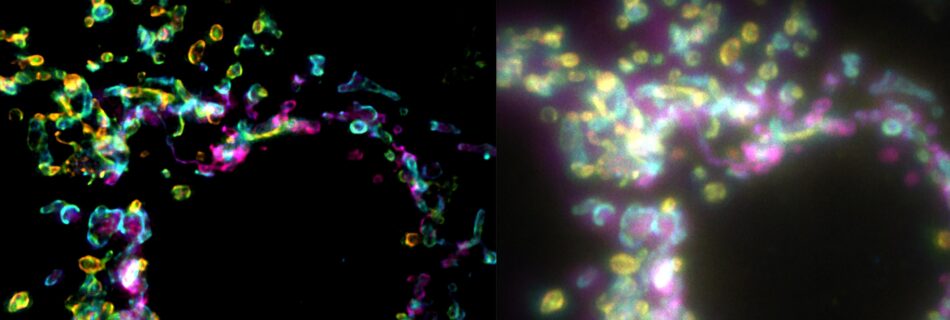
08.09.26 – A new fluorescence microscopy technique that generates super-resolution images from a single camera exposure could help researchers study rapid movements within cells that are difficult to capture with existing methods. Super-resolution microscopy has transformed cell biology by allowing scientists to see cellular structures and details that are too […]
Read MoreArticles by Cecilia
Scientists program materials just by spinning them
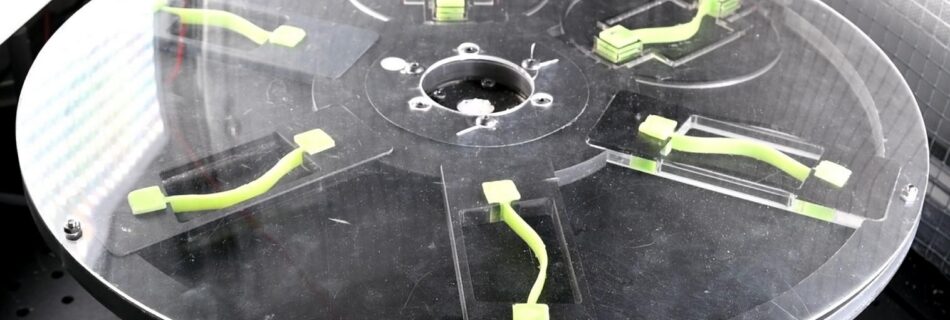
07.05.26 – A team including EPFL engineers has designed a rotating platform whose controlled spin can make flexible beams snap between two stable states. The simple, fast method can encode binary information directly into materials without electronics. There is something universally appealing about the slap bracelet, and the way a […]
Read MoreAI helps marine scientists track floating debris from space
09.03.26 – Under the EPFL-led ADOPT project, researchers are combining AI satellite-image recognition with drift prediction models to improve the collection of plastic debris in the ocean. The technology has passed the proof-of-concept stage and is ready for field testing. Being able to identify and track floating masses of debris is critical […]
Read MoreBetter particle control facilitates cancer therapy
25.01.26 – Protonica, an EPFL and CSEM spin-off in creation has developed a new imaging and detection technology that aims to make proton therapy – a highly precise form of cancer treatment – quicker, more effective and, ultimately, cheaper. Proton therapy, a form of radiotherapy that uses proton beams instead […]
Read MoreFrom Pixels to Insight
16.12.25 – A series that reveals the hidden side of image analysis in a few snapshots: 2. The Hidden Motion of Flexible Beams Researchers from the Flexible Structures Laboratory (FLEXLAB) have developed a new way to store and control information inside special mechanical materials made of tiny “switchable” elements. Instead […]
Read MoreFrom Pixels to Insight
19.11.25 – A series that reveals the hidden side of image analysis in a few snapshots: 1. Open-Source AI for More Reliable Measurement of Artery Narrowing Quantitative coronary angiography (QCA) is a computer technique that measures very precisely how narrowed a coronary artery is, providing more objective and consistent results, especially […]
Read MoreMapping the lipid blueprint of life in 4D
15.09.25 – Researchers at EPFL have created the first 4D lipid atlas of vertebrate development, revealing how fats shape our bodies from embryo to organism. We often think of embryonic development as a genetic ballet, choreographed entirely by DNA and proteins. But there’s another cast member quietly shaping the scene: […]
Read MoreNew method instantly characterizes thousands of molecules
05.08.25 – EPFL researchers have developed a new imaging method, based on the use of a single-photon camera, that can characterizes thousands of molecules quickly and simultaneously. The new method, inspired by an imaging technique that has been around for 35 years, takes ultraprecise measurements of a molecule’s unique light-emission […]
Read MoreSmart microscope captures aggregation of misfolded proteins
24.07.25 – EPFL researchers have developed a ‘self-driving’ microscope that can predict the onset of misfolded protein aggregation – a hallmark of neurodegenerative disease – as well as analyze the biomechanical properties of these aggregates. The accumulation of misfolded proteins in the brain is central to the progression of neurodegenerative […]
Read MoreA Catalyst for Innovation and Collaboration
03.07.25 – After four years of driving innovation in imaging science at EPFL, the Center for imaging has reached several important milestones: an update on its impact and future ambitions. Since its launch in 2021, the EPFL Center for Imaging has aimed at fostering excellence in imaging at EPFL by […]
Read More